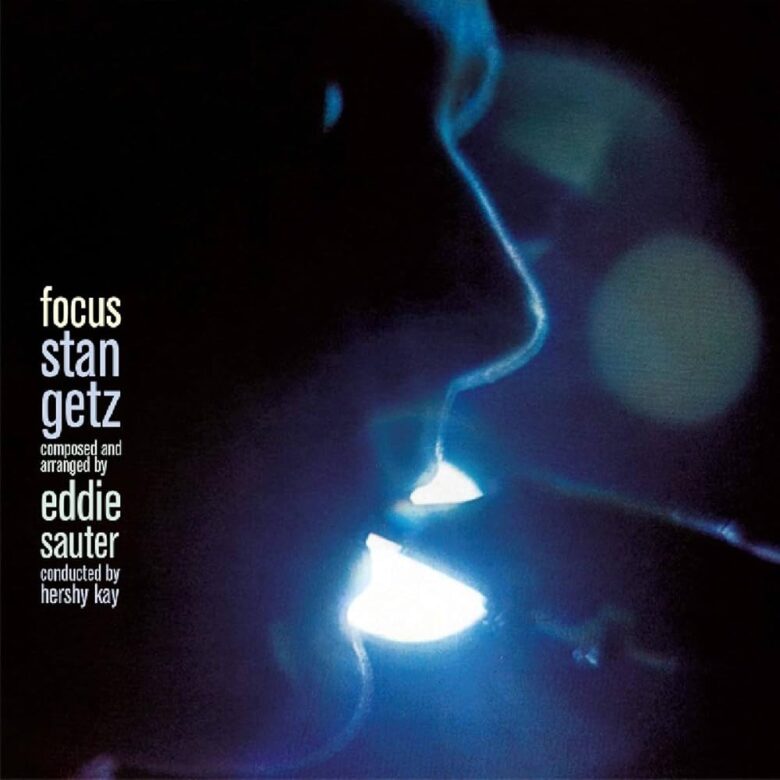
Jazz, whether hard-bop or free, is not some arcane art form nor is it reserved only for the cognoscenti. Jazz seems to have always lacked outlets to the mainstream that Britney Spears, Bach, and the Beatles have enjoyed. My father-in-law played saxophone in high school, formed his own jazz band, and thoroughly enjoys this musical genre. During my free jazz days, he gave me cds by Art Blakely, James Moody, and Charles Mingus. I listened to these jazz artists with mild interest. One day he gave me Focus (1961), a cd by one of his favorite jazz artists, Stan Getz. Focus has an unorthodox approach (redundant?) to jazz with its pairing of Getz’s tenor sax and a string quartet. Here is a summary of some of my jazz possessions.
Getz is best known for his bossa nova sound, and captured American listeners with the 1964 song, “The Girl From Ipanema.” Brazilian, his sweet bossa nova sound. When I saw a “Jazz Masterpiece” sticker on a Getz cd called Captain Marvel (1974), which included the name of pianist Chick Corea, I bought it. Its blistering opening track, “La Fiesta,” immediately grabbed me. The rest of the release proved uneven and subordinate. However, isn’t it also true that the Rolling Stones have less-than-stellar tunes on Sticky Fingers? Regardless, I endeavored to broaden my sonic palette with continued listening of the jazz segment on WNUR. One day I heard the DJ play a tune by Miles Davis called “Rated X.” What did I just hear? Miles on organ! So I bought Get Up With It and listened to it regularly in my cubicle for years. Released in 1974, GUWI, a brooding, funk-fusion classic, includes keyboardist Herbie Hancock, guitarist John McLaughlin, percussionist Mtume, among others. Davis had changed the jazz landscape to a fusion focus five years earlier with the release of Bitches Brew. Fusion became IT in the 1970s, connecting to my condition in the 21st century.
I knew of Herbie Hancock, due to his standout single “Rockit” from Future Shock, which was released while I attended college. ‘Twas quite the bridge between funk, electro, funk, and jazz. Hancock also flourished during the fusion era by releasing Mwandishi (1971), Sextant (1973), Headhunters (1973), and Thrust (1974). No, I did not forget about Miles. After introducing the fusion genre, he delivered the quintessential On the Corner (1972), the aforementioned GUWI, and Dark Magus (1977). Miles performed live extensively during this era, including a 1970 residency at the Fillmore East, which ultimately produced four hours on cd. Cannot forget about Live Evil (1971). Also in 1971, John McLaughlin founded the complex, jazz-fused, and intense Mahavishnu Orchestra with cast members Billy Cobham on drums (and favorite drummer of my son’s long-time drum instructor), keyboardist Jan Hammer, jazz violinist Jerry Goodman, bassist Rick Laird, and also other honored musicians over the band’s lifespan.
Son #2 decided approximately 17 years ago that he wanted to become serious about music…beyond his standard drum kit. Since he had been introduced in sixth grade to mallet instruments, e.g., tympani, xylophone and marimba, we bought him a 4 1/3 octave marimba, and employed Northwestern graduate students to advance knowledge, skills, and abilities. The marimba is so pleasing to the ear! My father-in-law then recommended I listen to the Modern Jazz Quartet. Milt Jackson, aka, “Wizard of the Vibes,” formed this jazz ensemble circa 1950, which continued until his death in 1999. I hit a jazz stride with mallet instruments. Enter Gary Burton, and Jason Adasiewicz (Sun Rooms) from the local jazz scene. I eagerly attended at least a dozen concerts that included Mr. Adasiewicz, typically on vibraphone. I attended the awesome (!) world debut of Starlicker-comprised of Rob Mazurek, Jason A. and John Herndon, and have watched their video many times
https://youtu.be/eItFUosAASE?si=abAlHsaxGqSTl9c0
I also saw an impressive concert with Gary Burton paired with a jazz guitarist, Julian Lage.
Out of preference, my gravitation to Getz, fusion and mallets do not include vocals. However, I am extremely impressed with Billie Holiday. Check out her hauntingly stark song called “Strange Fruit.” You may recognize Sweden’s Neneh Cherry from the MTV heyday. In the 21st century, Ms. Cherry released The Cherry Thing, featuring other Swedish musicians, including saxophonist Mats Gustafsson, Ingebrigt Haker Flaten on bass, vibes, and electronics, and Paal Nilsson-Love on drums and percussion. I’ve seen these guys in concert. I listened to The Cherry Thing yesterday.
Other releases by somewhat random jazz artists that I enjoy include pianist Sonny Clark (Leapin’ and Lopin’ – 1962), Chick Corea and Gary Burton (Native Sense – 1997), and saxophonist and composer, John Zorn. If you seek Latin jazz, check out Paquito D’Riviera. Critics and fans embrace pre-1969 Miles Davis eras; I have found my niche through “trial and error.” Other jazz luminaries such as Dave Brubeck, Thelonius Monk, John Coltrane, or violinist Jean Luc Ponty (he played with Zappa) may tickle your ear. Go for it and embark on your own jazz adventures!
Just my .02.
Ciao, ciao for now!