During my primary school years, I dressed in a red tomtë outfit, sang Nu Är Det Jul Igen* (It Is Christmas Again) with tomtën in a church basement, and danced around the Christmas tree to celebrate St. Lucia.Day (or Sankta Lucia). “Lucia,” an older female dressed in a white gown, would then appear, wearing a crown of candles while carrying a tray of cookies and treats. Swedish-American families have their own Lucia procession with the eldest daughter bringing coffee and treats in the early morning. My alma mater, North Park College/University, annually celebrates Sankta Lucia on campus. Years ago I attended a Sankta Lucia celebration at the Richard J. Daley Center because my sister had been honored the role of Lucia.
Lucy, a martyred Syracusan at age 21 in the fourth century during the Roman Empire, was one of the earliest Christians to be executed…either because of her faith or the accusation of being Christian. Medieval records indicate Lucy (luc-Latin for light) had her eyes gouged out before her execution. According to legend, St. Lucia would secretly bring food to the Christians hiding in Roman catacombs under the city. She would light her way with candles held in a wreath on her head so she could have both hands free to carry sustenance. When pagan Sweden accepted Christianity, each day of the year was given a saint. The one for December 13 was Saint Lucia, symbolizing the arrival of light during the darkest time of the year, i.e., the Winter Solstice.
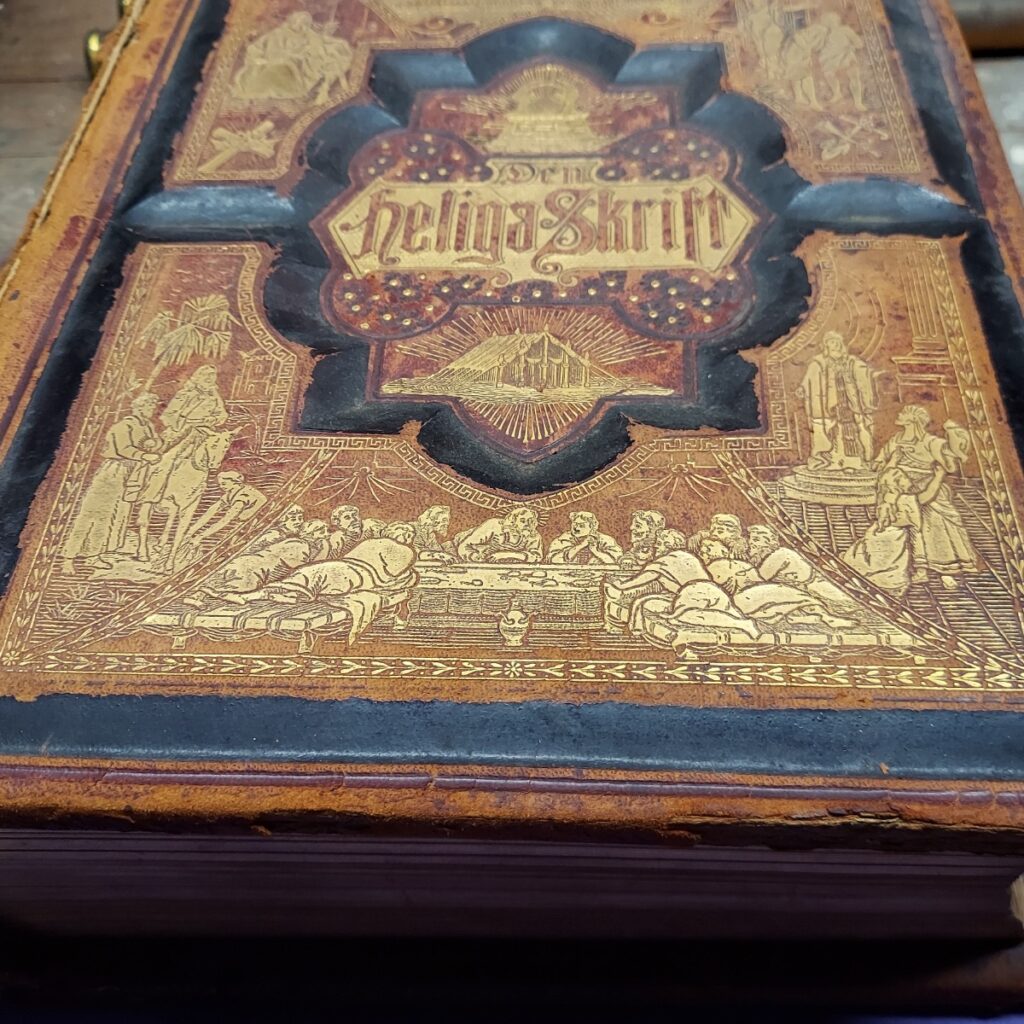
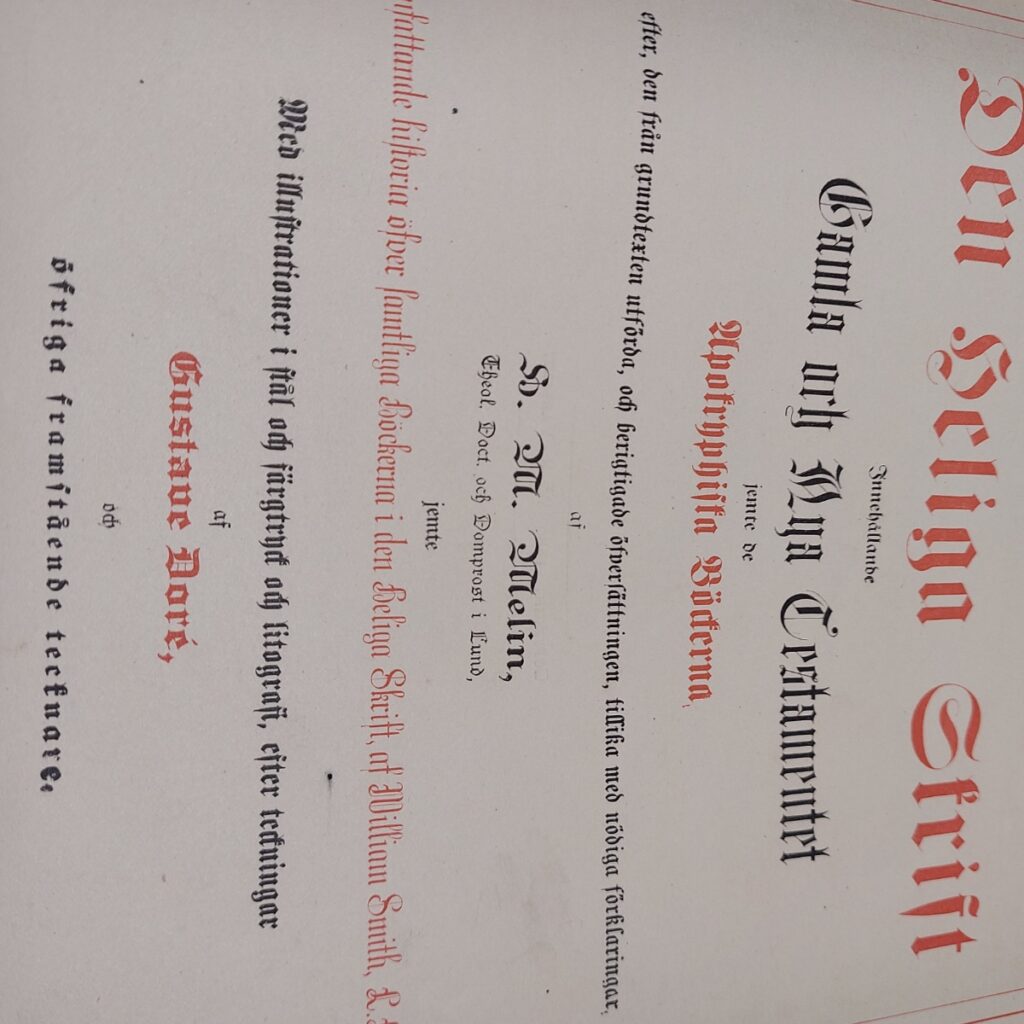
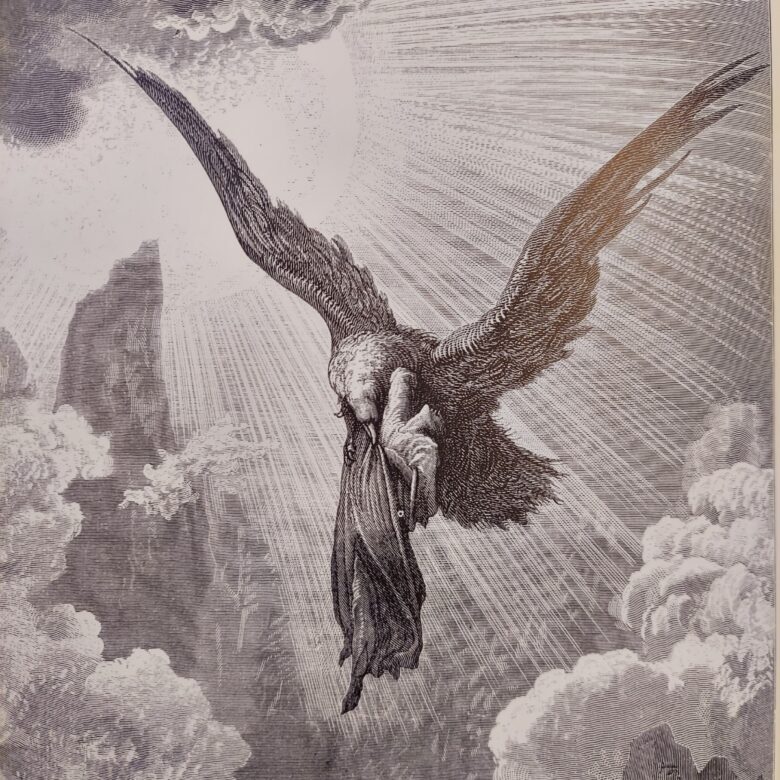
One day I found myself conducting research about Warner Sallman (1892-1968), a Swedish-American, lifelong Chicagoan, and master painter who is most recognized for his painting, the Head of Christ. Several of the artist’s well-known paintings are located at Anderson University. At https://anderson.edu/galleries/warner-sallman/ I noticed the phrase that Sallman “became interested in art at an early age and was especially impacted by the religious art of Gustave Doré.” I recognized this name, credited as the illustrator on all three of my 19th century Swedish Den Hellige Skrift (Swedish for The Holy Scripture) and my 100+ year old copy of Dante’s Inferno. Wait a minute, the same guy who famously illustrated Inferno at age 29 also has his illustrations in my 125+ year old Swedish Bibles??? I headed to the library to learn more about Doré (1832-1883) and also, Dante’s Inferno…of which I knew nothing.
What a fascinating trip it’s been! Dante, born in Florence (1265), became smitten with Beatrice as a teenager, but had his heart broken because her family arranged her marriage to someone else. At this time Florence’s commerce flourished to become a worldly financial empire, pushing aside feudalism, and the Florentine Ghibellines and Guelf factions clashed – one aligned with the Pope and the other with the Emperor. The infighting led Dante, the aspiring politician, to be expelled from Florence. He wrote as he wandered the country and during his respites with patrons. Inferno manifests Dante’s observations, reflections, and experiences in this era filled with tragedy, brutality and horror, and political and papal corruption. Dante’s epic poem describes the journey he and Virgil, the Roman poet revered by Dante, take within the Circles of Hell, Purgatory, and ultimately, Paradise. A Highway in Hell onward to a Stairway to Heaven.
During their grotesque tour, why did Dante and Virgil meet two Popes from Dante’s era, i.e., Adrian V and Nicholas III, per this tripartite poem? Specifically, Nicholas III, due to his simony and nepotistic hiring to an unprecedented degree, landed in the Eighth Circle of Hell (of nine total). Given the text, Doré’s illustration placed Nicholas upside down in a hole where its bottom contains fire. An upside-down baptism by fire – a most un-Catholic event! As Virgil and Dante continued their sojourn, he placed Adrian in Avarice, which is a cornice within Purgatory, due to the Pope’s love of riches to excess. Doré’s illustration of Adrian has him prone to the ground in the midst of a large number of spirits. At a different cornice, Virgil and Dante reach figures garbed in sackcloth with their eyes sewn up with thread to recompense for the sin of envy. (I thought about Alice in Chains’ Man In The Box video.) An angelic spirit of Beatrice helps Dante and Virgil navigate Purgatory.
Then this blog entry comes full circle: I noticed that Lucia, accompanied by Beatrice, appears in Purgatory! According to the 1996 translation by Robert Durling, Beatrice requested Lucia, the “enemy of all cruelty,” continue with the authors and “she turned her shining eyes, shedding tears, which made [Dante] quicker to come.” Thus, Lucy, martyred approximately 800 years before Dante’s birth and whose name itself is associated with light, played a special role in Dante’s life! The spirit of Lucy then carries Dante from a valley to the precipice of exiting Purgatory!!
I had never been taught that Lucia, the Patron Saint of Light, revered and celebrated by Swedish Americans, appeared in Purgatorio to help Dante navigate his path toward Paradise. Clearly, Dante venerated Lucy!