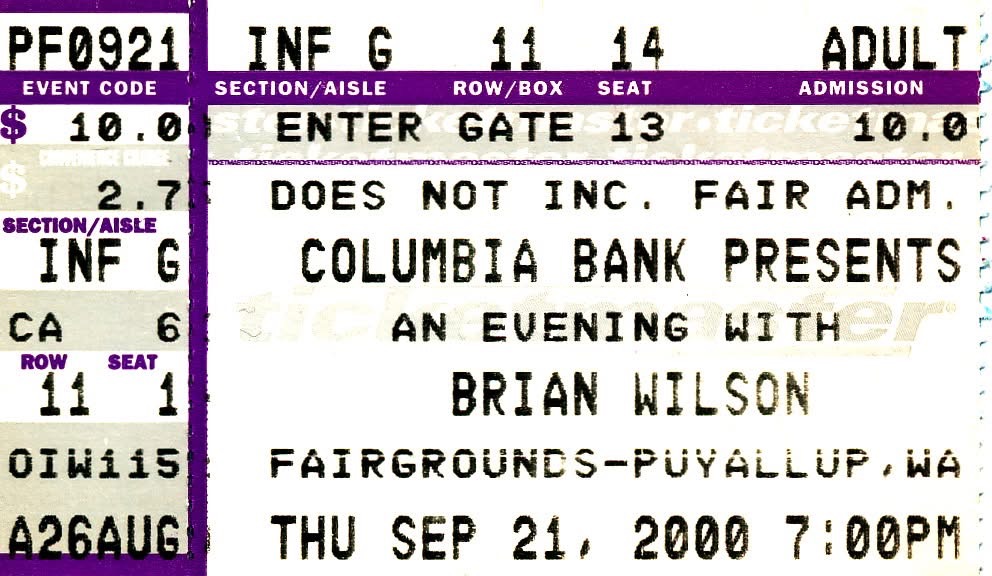
Brian Wilson made me cry on two separate occasions. The first time was during a 2000 concert at the Washington State Fair; he was performing the Pet Sounds album, plus assorted Beach Boys hits, with LA band the Wondermints as backup. It was so damn beautiful, the sound of it all; I wasn’t the only one in the audience shedding tears. And I’d just dried my eyes when photographs of Dennis and Carl appeared on a video screen. In that flat delivery of his, Brian simply and sadly said, “I miss my brothers” before launching into the next song. It was one of the most memorable and fortunate concert experiences of my life.
I didn’t begin to fully appreciate Brian’s legacy until twelve years earlier, until the release of his self-titled comeback — and its single “Love & Mercy.” It was the decidedly “new music” 80s, and I’d dismissed The Beach Boys’ made-for-transistor-radio, “surfing and hot rod” songs that had been omnipresent in the 1970s. I began to discover entire albums, rather than the hits found on the Endless Summer compilation that I had acquired at age 8. I soon immersed myself in Pet Sounds, in Surf’s Up. I had a good stereo, and for the first time I could marvel at Brian’s choice of instruments, at the arrangements. Playing songs over and over again, trying to dissect – as countless others have – the stupefying tracks. “Was that a tuba? Wood blocks? Kettle drum?” And Brian was just a kid when he’d made these records, supervising a studio – and a Wrecking Crew – in his early/mid-20s. Holey moley.
Brian Wilson had an extraordinarily beautiful voice, I realized. I had never cared much one way or another for frontman Mike Love’s pipes on most of their big hits, but Brian’s moments before a microphone were only rivaled by Carl’s; what harmonies. Brian was inspired by the Four Freshmen’s vocal magic, but the world was floored by The Beach Boys’ harmonies.
The Beach Boys’ music brings us back to simpler times, it’s been said. Ironic, for the 60s were hardly simple. “The Warmth Of The Sun” was Brian’s visceral, immediate reaction to JFK’s assassination; his genius peaked during the Vietnam war, during the heat of civil rights unrest. “Simpler times”… I think, rather, Brian’s compositions are escape vehicles to times of youthful joy, to the relative innocence and the more straightforward emotions of our salad days. More than half a century later, the songs remain simultaneously nostalgic and relevant. Truly timeless.
As with The Beatles, every Beach Boys fan has his or her own cache of favorites, songs that are as ingrained as childhood lessons. I certainly have mine, now playing as I write: the autobiographical “I just Wasn’t Made For These Times,” the love entanglements of “Girl Don’t Tell Me” and “Let Him Run Wild;” the dog-whistle, opening calliope-notes of “Wouldn’t It Be Nice.” I’ve been masochistically crushed by the sadness of “Caroline, No” hundreds of times, and have repeatedly lost myself in “Surf’s Up” – a near-mythical composition that some might cite as proof of a deity.
Also in my bag, of course, is “Don’t Worry Baby,” the quintessential American rock ’n’ roll song – though many – including McCartney – would counter this statement with Brian’s “God Only Knows.” I won’t argue with Sir Paul.
I’ve never dreamed of interviewing Brian; an audience with the Pope would’ve been more realistic. However, I got within a degree of him. Many years ago, I interviewed legendary session bassist Carol Kaye, who mentioned Brian without prompt. Ten years later, I talked to former Saturday Night Live short-film director Gary Weis, who directed a 1978 TV special-segment where The Blues Brothers rousted Brian out of bed to go surfing. Thankfully, Weis brought that day up; I was absolutely thrilled to hear him remember it.
I had almost walked into Brian Wilson once, when I wandered out-of-bounds at the Seattle Kingdome. The Beach Boys were playing a concert after a Mariners game; minutes before showtime, out of an elevator comes the band. They walked right by me. I was too stunned to say or do anything but stand there.
Brian was revered as a musician, an icon – and as an improbable survivor. He weathered an abusive father, only to develop crippling mental illness. Brian survived a long, self-destructive slide into semi-isolation, only to be “rescued” by a therapist who controlled him emotionally, creatively and financially for many years. However, Brian emerged from the wreckage to enjoy a victory lap that lasted more than 25 years, until his wife Melinda passed away in 2024.
Victorious, but damaged. That is the tragic, but essential aspect of the Brian Wilson legend. His almost child-like speech, his fragile, vulnerable persona…. he garnered so much concern from fans, for so long. The creator of “Good Vibrations” had more people in his corner than every boxer in history. Brian seemed to be a combination of Beethoven and Chance The Gardener – though, unlike Chance, there was no chance that Brian was a god. He was no saint, yet his traumas and triumphs were epic; almost biblical. For a rough handful of years’ worth of seemingly divine inspiration, the man had paid an enormous sum.
Brian wasn’t made for his time, and he certainly wasn’t made for this era of fear and confusion amidst officially sanctioned hate. If there was a fitting time for his departure, perhaps that moment is now.
This afternoon, Brian Wilson prompted me to shed tears again. I really don’t know why; California’s favorite son had lived a long life – and was in failing health. For many years, he was blessed with the love of countless admirers. Still… thoughts of his passing are as overwhelming as his music.
Brian Wilson, one of the most compelling and treasured musicians of my – or anyone else’s – lifetime, has gone to be with his brothers at age 82.